


Company News
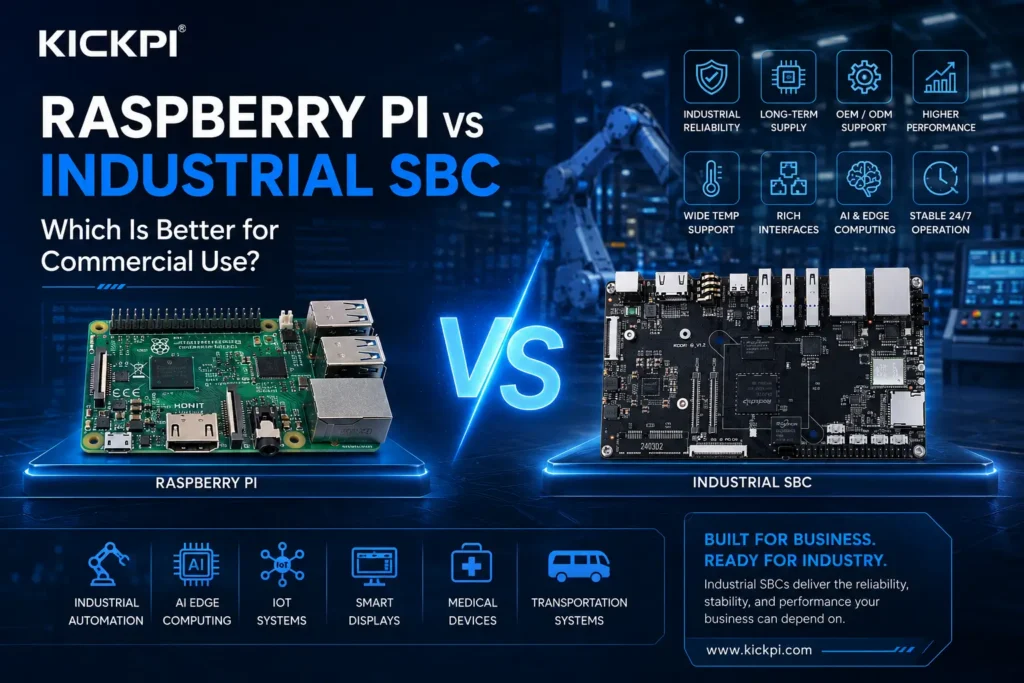
Raspberry Pi vs Industrial SBC: Which Is Better for Commercial Use?
May
When people start building embedded systems, automation projects, or smart industrial solutions, one of the first questions they ask is:
Should we use Raspberry Pi or an industrial single board computer?
At first glance, both seem similar. Both are compact computing platforms, both support development work, and both can be used for projects like IoT, AI, industrial control, and commercial display systems.
But once a project moves from testing to real business use, the differences become much more important.
A Raspberry Pi is often great for learning, prototyping, and small development work. But for long-term industrial use, many businesses need something stronger, more stable, and easier to scale.
That is where an industrial single board computer becomes the better choice.
In this guide, we’ll break down the real differences between Raspberry Pi and industrial SBC solutions so you can choose the right platform for your business.
What Is a Raspberry Pi?
Raspberry Pi is one of the most popular single board computers in the world. It is widely used by students, developers, hobbyists, and engineers for prototyping and testing.
It is affordable, flexible, and has a large developer community, which makes it a strong choice for learning and early-stage product development.
Common use cases include:
- IoT projects
- Smart home systems
- Basic automation
- Education and training
- Lightweight media systems
- Prototype testing
Raspberry Pi works very well when the goal is experimentation, software development, or proof of concept.
But commercial deployment often requires more than that.
What Is an Industrial SBC?
An industrial single board computer is built for long-term, stable, and continuous operation in real working environments.
Unlike consumer-level development boards, industrial SBCs are designed for:
- factory automation
- industrial control systems
- medical equipment
- commercial display systems
- AI edge computing
- transportation systems
- enterprise IoT deployments
These boards are made for reliability, hardware stability, extended product life cycles, and better OEM/ODM customization.
They are not just development boards.
They are business-ready computing platforms.
Raspberry Pi vs Industrial SBC: Key Differences
1. Reliability for Long-Term Operation
Raspberry Pi performs well for development, but industrial environments are different.
Factories, industrial control systems, and commercial hardware often run 24/7 for years. This requires strong thermal control, stable voltage handling, and industrial-grade durability.
Industrial SBCs are built specifically for this.
They are designed for continuous operation, while Raspberry Pi is mainly built for general-purpose use.
For businesses, reliability is often more important than low cost.
2. Supply Stability for Businesses
One major challenge with Raspberry Pi is supply consistency.
Many companies have faced stock shortages and sudden availability issues, which create problems for manufacturing and product scaling.
For B2B businesses, stable supply matters a lot.
Industrial SBC manufacturers usually provide:
- long-term production cycles
- stable inventory
- OEM production support
- better lifecycle management
This is critical when products move from prototype to mass production.
3. Hardware Customization
Raspberry Pi is mostly fixed.
If your business needs custom ports, industrial interfaces, carrier board design, or hardware modifications, the options are limited.
Industrial SBC manufacturers often provide:
- custom single board computer design
- custom carrier boards
- interface expansion
- OEM / ODM services
- hardware optimization for specific projects
This makes industrial SBCs much better for commercial deployment.
4. Industrial Performance
Many industrial applications need:
- multiple Ethernet ports
- GPIO expansion
- better HDMI output
- AI acceleration
- stronger processors
- industrial temperature tolerance
Boards built with platforms like Rockchip RK3568, RK3576, and RK3588 are designed for these needs.
This gives industrial SBCs stronger real-world performance for business systems.
5. Software Environment
Raspberry Pi has excellent community support.
That is one of its biggest strengths.
But industrial projects often require:
- long-term Linux support
- Android system integration
- driver-level customization
- embedded Linux optimization
- technical engineering support
Industrial development board manufacturers usually provide direct technical support, which is often more valuable than community forums.
When Raspberry Pi Is the Better Choice
Raspberry Pi is still an excellent choice when:
- you are building a prototype
- you are testing a new idea
- the project is small-scale
- low cost is the main priority
- the environment is non-industrial
- fast development matters most
For startups and proof-of-concept work, Raspberry Pi can save time and cost.
It is often the right first step.

When an Industrial SBC Is the Better Choice
An industrial single board computer is the better choice when:
- the product will be sold commercially
- the system must run 24/7
- long-term supply is important
- OEM or ODM production is needed
- industrial reliability is required
- AI, IoT, or industrial automation is part of the system
This is where industrial SBCs create real long-term value.
They reduce operational risk and support business growth.
Which One Is Better for Commercial Use?
For learning and prototyping, Raspberry Pi is often enough.
For real commercial deployment, industrial SBCs usually win.
The decision should not be based only on price.
It should be based on:
- reliability
- production stability
- long-term support
- hardware flexibility
- total business cost
A cheaper board can become more expensive later if it creates downtime, supply issues, or scaling problems.
That is why many businesses eventually move from Raspberry Pi to industrial development boards.
How KickPi Supports Industrial SBC Projects
KickPi provides high-performance single board computers and development boards for businesses that need stable, scalable embedded solutions.
Our boards support:
- industrial automation
- AI edge computing
- IoT systems
- commercial display solutions
- medical technology
- OEM / ODM customization
With platforms like KickPi K7, K2B, and custom development board solutions, we help businesses move from prototype to production with confidence.
Whether you need a standard industrial SBC or a fully customized embedded solution, our team supports both hardware and software integration.

Final Thoughts
Raspberry Pi is one of the best development boards for learning and prototyping.
But when reliability, production stability, and business growth matter, industrial single board computers are often the better long-term decision.
The right choice depends on your project goals.
If you are building for commercial use, choosing the right hardware early can save a lot of time, money, and operational risk later.
That decision matters more than most people realize.
