


Company News
Custom SBC Manufacturing: What Businesses Need Before Ordering
Jun
Most of the conversations that go sideways in custom SBC manufacturing don’t start with a bad manufacturer. They start with a buyer who came in underprepared.
Not underprepared in an obvious way, the product idea is usually solid, the market need is real, and the team is serious. What’s missing is the specific documentation, the compliance thinking, and the commercial clarity that a manufacturer needs before they can turn a concept into a board that ships in volume. Without those things, projects stall, revision cycles multiply, and timelines stretch in ways that could have been avoided.
This piece is written for the procurement manager, the hardware lead, or the founder at a company that’s moving from a development board prototype to a custom embedded product. It covers what you actually need to prepare technically, commercially, and legally before you engage a custom SBC manufacturer. Where relevant, it references how Kickpi’s OEM/ODM customization service handles each of these areas, since that’s the context this is written for. But the framework applies broadly.
OEM or ODM: Get This Decision Right First
Before any technical conversation, you need to know which engagement model fits your situation. The difference between OEM and ODM isn’t just terminology; it changes what you bring to the table and what the manufacturer provides.
In an OEM engagement Original Equipment Manufacturer the manufacturer produces hardware to your specification. You own the design. You provide the schematics, the PCB layout files (Gerbers), and the Bill of Materials. The manufacturer builds to that spec and may apply your branding. This model suits companies that have internal hardware engineering capacity and want manufacturing-only support, or companies bringing an existing certified design to a new production partner. Kickpi’s OEM service is structured for clients who come with a working prototype and need production capability.
In an ODM engagement, the Original Design Manufacturer does the design work. You specify what the board needs to do: the processor family, the I/O requirements, the form factor constraints, the operating environment, and the software platform. The manufacturer’s engineering team handles schematic capture, PCB layout, component selection, and prototype validation. This is the right model for companies with a clear product concept but without dedicated hardware engineering resources.
Choosing the wrong model wastes time on both sides. If you’re coming in with a half-finished design expecting full ODM support, or arriving with a rough concept expecting OEM pricing, you’ll need to reset the conversation. Know which one you are before the first call.
A third path, less commonly labeled but worth knowing, is starting from scratch entirely, where the manufacturer takes a product brief and owns the complete design process from concept through production. This is full ODM, and it requires more upfront time spent on requirements definition to work well.

The Technical Package: What You Need to Bring
Regardless of whether you’re pursuing OEM or ODM, there’s a minimum set of technical documentation that any serious custom board manufacturer will need before they can quote accurately, let alone begin work. Getting this together before the first conversation saves multiple back-and-forth cycles.
Hardware specification document
This is the foundational document. It defines what the board must do, not how it does it, but what the result needs to be. A useful hardware spec covers the processor family and minimum compute requirements, memory and storage configuration, all required I/O interfaces (down to count and type, not just “serial” but “two RS-485 ports with hardware flow control”), power input range, display output requirements, connectivity (Ethernet, Wi-Fi, cellular), and any environmental ratings the board needs to meet.
If your spec is vague or incomplete, you’ll get a quote that reflects that vagueness, either padded to cover unknowns or priced against assumptions that don’t match your actual requirements. A clear spec is also what protects you contractually if deliverables drift during the project.
Gerber files and schematics (OEM path)
If you’re pursuing an OEM engagement and have an existing design, you need to provide Gerber files, the industry-standard format for PCB manufacturing data, along with the schematic source files and a full BOM. Gerber files define the physical board: copper layers, silkscreen, solder mask, and drill holes. Without them, the manufacturer is guessing at your board geometry and layer stack-up.
Gerber files should come from a validated design. A manufacturer can flag obvious issues during design review, but they’re not responsible for design flaws that weren’t disclosed. If your board hasn’t been through a Design Rule Check (DRC) against the manufacturer’s process capabilities, that should happen before the files go out.
Bill of Materials
The BOM is where custom SBC projects most often run into problems during manufacturing, and it’s worth spending real time on it. A good BOM specifies every component with the manufacturer part number, approved alternates, and current availability status. It flags any components with long lead times, single-source dependencies, or known supply chain volatility.
Component availability has become a harder problem than it used to be. A BOM built entirely around components with 52-week lead times creates production scheduling problems that no manufacturer can solve without significant buffer stock or expensive spot market purchases. If you don’t know the lead time profile of your BOM, find out before you start talking to manufacturers. For industrial-grade custom boards, the kind where long-term supply continuity matters, this is also where the conversation about approved vendor lists (AVLs) becomes important. It’s part of why Kickpi’s customized board engagements include BOM review as an early step rather than an afterthought.
Functional requirements and test criteria
What does a passing board look like? This sounds like an obvious question, but it’s one that a surprising number of custom board projects don’t answer clearly until they’re in production validation. Define the functional test criteria upfront: what tests get run on every board, what the pass/fail thresholds are, and who owns the test fixture design. Suppose you need in-circuit testing (ICT), boundary scan, or a custom burn-in procedure.That has to be specified before prototyping begins, not discovered during acceptance testing of the first production run.
Choosing the Right Base Platform
One of the decisions that has the most downstream impact on BOM cost, software development effort, long-term supply, and time to market is which processor platform you build around.
For most custom embedded board projects in 2026, the choice is between starting from scratch with a custom processor selection or building around a proven SoC with an existing BSP and software ecosystem. The second path is almost always faster and lower risk, particularly for companies that don’t have dedicated firmware teams.
The Rockchip RK3576 and RK3588 platforms are a common starting point for industrial and edge AI custom boards, in part because the software ecosystem is mature, maintains BSPs, Ubuntu 24.04 support, and RKNN-Toolkit2 for AI inference and in part because the SoC vendor has made credible long-term supply commitments. The Kickpi K7 (RK3576) and K8 (RK3588) serve as reference designs in Kickpi’s ODM process: a client who wants a custom board with different I/O, a different form factor, or additional interfaces can start from a known-good reference rather than blank silicon.
If your application is less compute-intensive than an IoT gateway, a serial-to-Ethernet converter, or a display control panel, the RK3568 family (as used in the K1 and K1B) offers the same BSP maturity at a lower BOM cost. The right platform for your application depends on what the board actually needs to do, not on which chip has the highest headline specs.
Starting from a proven reference platform reduces your BSP development cost, shrinks the firmware validation surface, and gives you a component with a known production track record. For most custom board projects, that’s worth more than the marginal flexibility of an unconventional chip choice.
For a broader look at how ARM platforms compare to x86 alternatives in embedded and industrial contexts, which often comes up in the platform selection conversation, the ARM vs. x86 SBC comparison covers the tradeoffs in detail.
What the R&D Process Actually Looks Like
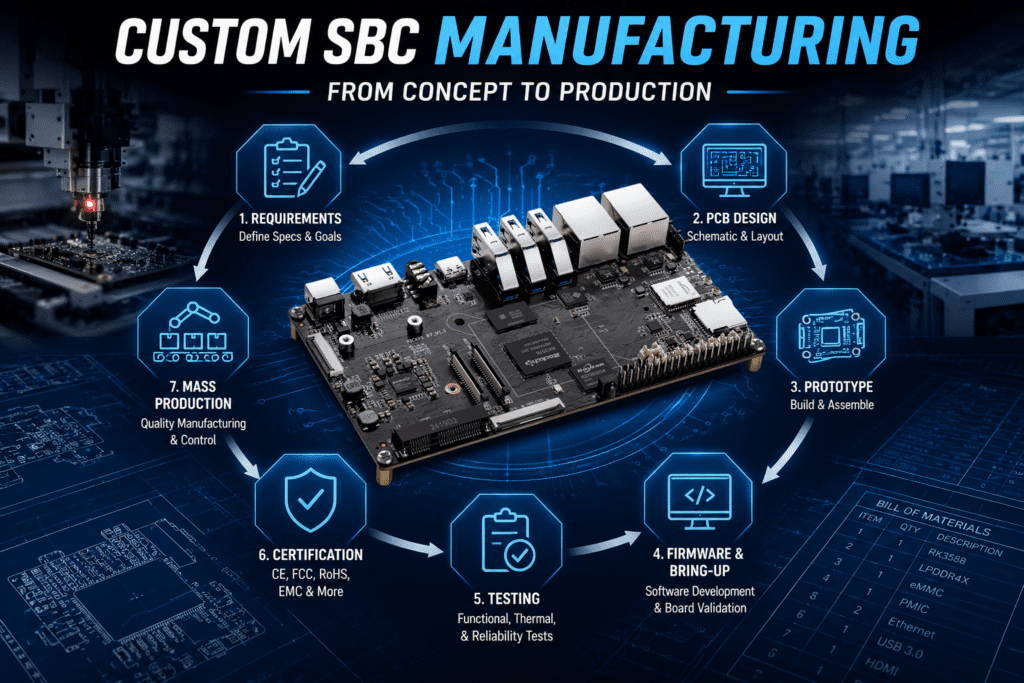
Companies that haven’t been through a custom board project often underestimate how many stages there are between concept and production-ready hardware. Understanding the process helps you set realistic timelines, allocate review bandwidth internally, and avoid the delays that come from being surprised by a stage you didn’t know existed.
Schematic design and review
If you’re on the ODM path, the manufacturer’s engineering team handles schematic capture, translating the functional requirements into a complete circuit diagram. If you’re on the OEM path, you provide schematics, and the manufacturer reviews them against their process capabilities and component availability. Either way, schematic review is a gate that shouldn’t be rushed. Errors caught at the schematic stage cost hours. The same errors caught during PCB layout cost days. Caught in prototype testing, they cost weeks and a new board spin.
PCB layout and Design Rule Check
PCB layout translates the schematic into a physical board design, routing traces, placing components, and defining the layer stack-up. The layout has to satisfy both the electrical requirements of the design and the manufacturing capabilities of the fab house: minimum trace widths, via sizes, copper-to-edge clearances, and impedance-controlled routing for high-speed interfaces like DDR memory and USB 3.0.
A Design Rule Check (DRC) runs the completed layout against the fab’s process rules before Gerbers are generated. Any DRC violations are either corrected or explicitly waived with engineering justification. Skipping DRC or running it against the wrong process parameters is how boards come back from the fab with manufacturing defects that have nothing to do with the design intent.
CNC machining and rapid prototype fabrication
For mechanical validation, confirming that the board fits the intended enclosure, that connector positions align with panel cutouts, and that thermal management hardware clears component height tolerances, CNC-machined prototype enclosures are typically made alongside the first PCB prototype run. This catches physical integration issues before they’re embedded in tooling.
First-article prototypes are usually built in small quantities (5–20 boards) using production-equivalent processes and components. The goal is to validate that the design works before committing to tooling costs and component buffer stock for production volumes.
Firmware bring-up and validation
Getting a new board to boot for the first time is only the beginning of firmware validation. The bring-up process involves verifying every peripheral interface against the hardware spec, running memory stress tests, validating power sequencing across the full operating temperature range, and confirming that the BSP supports the specific silicon revision that will be used in production.
For custom boards based on established SoC platforms, BSP bring-up is substantially faster than for novel chip selections; there’s a working reference to start from rather than bare-metal driver development. This is one of the practical advantages of building on a platform like RK3576 or RK3588 with a mature Kickpi BSP foundation.
Validation and qualification testing
Before a board goes to production, it needs to pass a qualification test battery. This typically includes: functional testing of all interfaces, thermal cycling across the operating temperature range, power input range validation (including overvoltage and reverse polarity protection), EMC pre-compliance testing, and, if the board will be used in vibration-prone environments, mechanical stress testing. Qualification test results are documented and kept on file as part of the production design record.
Compliance: Plan for It Early, Not at the End
Certification is a part of custom board projects that most commonly causes delays, usually because it was treated as something to handle after the design was finalized, rather than a constraint that shapes the design from the beginning.
CE marking (for EU markets), FCC authorization (for US markets), and RoHS compliance (materials restriction, essentially global) are the baseline requirements for most commercial embedded products. UKCA for post-Brexit UK markets. UL for North American safety certification. If your product goes into medical devices, automotive systems, or industrial machinery, additional sector-specific certifications apply.
The reason to plan for compliance early is that EMC performance, the electromagnetic compatibility behavior that determines whether your board passes conducted and radiated emissions testing, is heavily influenced by PCB layout decisions. Board-level EMC is affected by trace routing, power plane design, decoupling capacitor placement, and connector filtering. These are things that are straightforward to address during the layout stage and expensive to retrofit after a prototype has been built.
EMC testing failure on a prototype isn’t uncommon. But an EMC failure that’s caused by a layout decision that was made without considering the test requirements is avoidable. The fix usually means another board spin cost and schedule impact that proper upfront planning eliminates.
Pre-compliance EMC testing running the board in a shielded environment with a near-field probe to identify emission hotspots before formal testing is available at most contract test labs, and is worth the cost on any board going to commercial production. It gives you actionable data to address before the formal certification test, rather than walking in blind.
For boards going into industrial environments, functional safety requirements may also apply: IEC 61508 for general industrial safety and ISO 13849 for machinery. These are more demanding than basic CE/FCC certification and affect both hardware design and firmware architecture if your application domain includes safety requirements that need to be established before schematic design begins. The industrial control applications that Kickpi’s boards target include standard CE/FCC-certified designs; safety-function-specific requirements are handled through the customization engagement.
MOQ, Pricing, and the Commercial Conversation
The commercial side of a custom SBC engagement involves terms that can catch buyers off guard if they’re used to purchasing off-the-shelf development boards. Here’s what to expect and what to negotiate.
Minimum order quantity
Custom SBC manufacturing includes NRE (non-recurring engineering) costs – the one-time cost of engineering design, tooling, and setup that don’t scale with volume. To amortize those costs to a reasonable unit price, manufacturers need a minimum order quantity. For a simple customization of an existing reference design, MOQs might start at 100–500 units. For a ground-up custom design with a new PCB layout and enclosure tooling, MOQs of 500–1,000 units or more are common.
If your projected volumes are below the manufacturer’s standard MOQ, the conversation isn’t necessarily over, but the per-unit economics change. NRE costs are either absorbed by the manufacturer (and recovered through higher unit pricing) or charged separately. You need to know what model you’re working under so you can budget accordingly.
NRE and tooling costs
NRE covers engineering time, prototype fabrication, test fixture development, and any custom tooling (molds for enclosures, custom cable assemblies, specialized test equipment). These are usually quoted separately from unit pricing and paid upfront or upon prototype delivery. For a full ground-up ODM engagement, NRE is the cost of the manufacturer’s engineering time; for a simpler OEM production engagement, NRE covers setup and tooling only.
NRE is negotiable within limits. Manufacturers will sometimes share or waive NRE costs for customers who commit to larger volume orders. But be cautious about deals where NRE is entirely waived: the cost doesn’t disappear, it gets embedded in unit pricing, and if your volume doesn’t materialize, you’ve effectively paid NRE anyway at a higher rate.
Long-term supply agreements
This is especially important for industrial and commercial products with multi-year production runs. A long-term supply agreement (LTA) commits the manufacturer to supply a specific board configuration at agreed pricing for a defined period, typically 3–5 years. LTAs usually include provisions for component substitution notification (so you know if a critical component changes), annual pricing reviews, and minimum purchase commitments.
Without an LTA, you’re exposed to the manufacturer discontinuing the product, changing the BOM without notice, or raising prices significantly at renewal. For products where recertification after a hardware change is expensive, that exposure is real. It’s one of the questions worth asking explicitly when evaluating any custom board manufacturer. Kickpi’s customized service model is built around clients who need multi-year supply continuity. That’s a different customer than someone buying a development board for a one-off project.
IP ownership
Clarify upfront who owns the design files at the end of the engagement. In a true OEM arrangement, you own the design that the manufacturer is producing to your spec, and you retain the Gerbers, schematics, and BOM. In an ODM arrangement where the manufacturer does the design work, IP ownership is negotiable and should be defined in the contract before work begins. Some ODM manufacturers retain the design and license it to you; others transfer full ownership upon payment. Neither is inherently wrong, but you need to know which one it is before signing.
OEM vs. ODM: Which Engagement Model Fits Your Situation
The table below helps map your situation to the right engagement model before you start the conversation with a manufacturer.
| OEM Engagement | ODM Engagement | |
| What you bring | Complete schematics, Gerbers, BOM | Product brief, functional requirements, market context |
| What the manufacturer provides | Production, assembly, test, logistics | Schematic design, PCB layout, BOM, prototype, production |
| IP ownership | Buyer retains full ownership | Negotiated define in contract before work starts |
| Who it suits | Companies with hardware engineering team and existing design | Companies with product concept but no dedicated hardware team |
| NRE cost | Lower tooling and setup only | Higher covers engineering design plus tooling |
| Timeline to first prototype | Faster design is done | Longer 8–20 weeks depending on complexity |
| Risk profile | Design risk stays with buyer | Design risk shared with manufacturer |
What a Serious Custom Board Manufacturer Does Differently
Not all custom SBC manufacturers are the same, and the differences show up in ways that aren’t always visible in a quote.
A manufacturer who has done this seriously for industrial and commercial clients will push back on vague requirements before accepting them. They’ll flag BOM components with known supply problems before prototyping begins. They’ll have a documented qualification test protocol rather than an informal “we tested it, and it works.” They’ll have CE/FCC test reports you can actually read, not just a compliance statement on a webpage.
Kickpi was founded in 2021 specifically as a customized development board provider; the OEM/ODM service isn’t a secondary revenue line added to a product catalog, it’s the founding rationale. The about page documents this. The available product lineup serves as a library of reference designs that ODM projects build from, which means clients benefit from BSPs and hardware layouts that have already been through production validation rather than starting every engagement from zero.
The questions worth asking any custom board manufacturer before committing: What does your prototype-to-production process look like, and where are the review gates? How do you handle component substitutions when a BOM part goes EOL? What does your LTA look like, and what triggers a price renegotiation? Can you share EMC pre-compliance results from comparable previous projects?
The answers tell you more about what the engagement will actually be like than the initial quote does.
Before You Make the Call
The companies that get the most out of a custom SBC engagement are the ones that come in with a clear product vision, documented technical requirements, and realistic expectations about timeline and cost. That doesn’t require a hardware engineering team; it requires having thought before the conversation starts.
If you’re at the stage of evaluating whether a custom board is even the right path versus adapting an existing SBC, it’s worth mapping your requirements against available reference boards first. Sometimes an off-the-shelf board with minor software customization is faster and cheaper than a custom design. Sometimes the requirements genuinely demand a custom board. The difference usually comes down to volume, form factor, I/O specificity, and branding requirements.The Kickpi customized services page covers the full range of what’s available: hardware customization, software customization, OEM and ODM paths, and the one-stop service model for companies that want to hand off more of the development process. For context on the reference platforms that most engagements build from, the K7 (RK3576) and K8 (RK3588) product pages cover the specs in detail, and the top ARM boards guide gives broader context on the platform options worth considering.
